Every year, thousands of Belgian drivers go to the technical inspection without checking simple points, and leave with a red card or a re-inspection. Most reasons for refusal concern defects visible to the naked eye, correctable in a few minutes at a garage or even at home. Preparing your vehicle for the technical inspection in Belgium does not require advanced mechanical skills, but a precise method.
Reform of the technical inspection in Flanders: what changes in September 2026
Before even thinking about mechanics, you need to know in which region you plan to have your inspection. Flanders will implement a biennial inspection starting from September 1, 2026 for all passenger cars over four years old, with no age or mileage limit. Wallonia and Brussels will maintain an annual rhythm starting from a certain age or mileage.
This discrepancy has a direct consequence on preparation. A valid Flemish certificate for two years encourages some Walloon and Brussels drivers to consider having their inspection at a Flemish center. The Belgian press is already talking about a phenomenon of “technical inspection tourism” towards Flanders. It is legally possible, but Flemish centers may see their waiting lines grow.
Another notable change in Flanders: the deadline for repairs after a red card extends to two months instead of fifteen days. And the insurance certificate is no longer required during the visit, as the inspection is conducted via ANPR cameras. In Wallonia and Brussels, these documents remain mandatory.
To find a control center and make an appointment, drivers can go through Auto Test, which groups several stations in Belgium.
Defects that cause a re-inspection at the technical inspection
Competitors often list ten reasons for refusal. Let’s focus on the three categories that represent the vast majority of failures because these are the ones where your preparation really makes a difference.
Faulty lighting
This is the primary reason for refusal. A burnt-out bulb on a brake light, a turn signal flashing too quickly (a sign of a defective bulb), a poorly adjusted headlight. Checking the lighting takes five minutes.
Park facing a wall in the evening. Activate the low beams, high beams, fog lights, turn signals, and hazard lights. Walk around the vehicle. Ask someone to press the brake pedal while you check the rear brake lights. Just one burnt-out bulb is enough for a re-inspection.
Tire wear and wheel condition
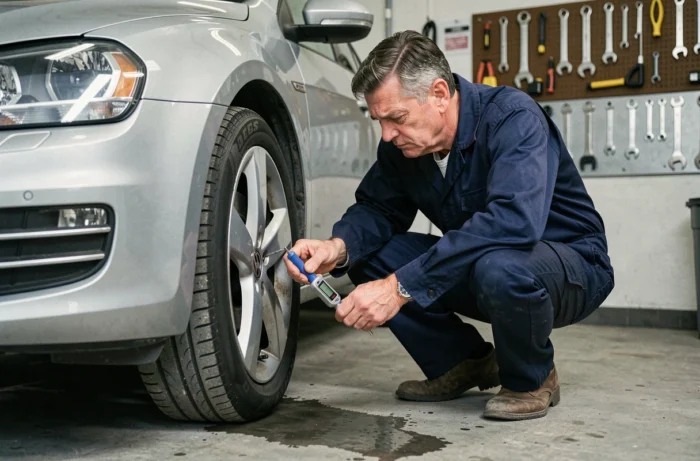
The inspector measures the depth of the treads. The legal limit is set by Belgian regulations, and a tire close to this limit will be flagged. Also check for asymmetric wear, which indicates a geometry problem. Cracked sidewalls or bulges (bumps on the side of the tire) lead to a refusal.
All four tires must be of the same type per axle: no mixing of summer and winter tires on the same axle.
Insufficient braking
The brake bench measures the effectiveness and balance between the wheels. A significant imbalance between the left and right wheels causes a refusal. Before the visit, drive a few kilometers and brake gradually to feel if the vehicle pulls to one side. A metallic rubbing noise indicates worn brake pads down to the indicator.
Documents and vehicle condition on the day of the visit
You have repaired the visible mechanical defects. Now, avoid failing for an administrative reason or a detail of appearance.
Documents to gather
The list varies depending on the type of inspection. Here is the minimum for a periodic inspection:
- The registration certificate (the “car” section for a periodic inspection, both the “home” and “car” sections for a used car inspection)
- The vehicle’s certificate of conformity
- The insurance certificate (except in Flanders starting September 2026)
- The previous inspection certificate if the vehicle has already been inspected
- For utility vehicles: the technical sheet or identification report
Also check the validity date of your inspection certificate. An inspection conducted late can result in a fine.
General condition required
The vehicle must be presented empty. Empty the trunk, remove heavy objects. Only permanently fixed items may remain inside. Only one person may be in the vehicle during the inspection.
Ensure that your license plates are readable, not cracked, and properly fixed. A dirty or damaged plate is a reason for a remark, or even refusal.
Checks under the hood before the technical inspection
The inspector does not disassemble anything, but visually inspects the engine compartment and checks the levels. These points can be checked in a few minutes:
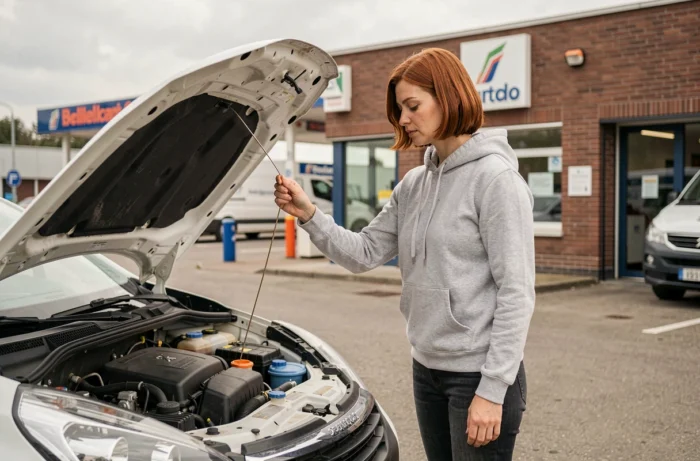
- Engine oil level between the min and max marks on the dipstick
- Coolant level visible in the expansion tank
- Brake fluid level in the reservoir (a low level indicates worn pads or a leak)
- Absence of visible leaks under the vehicle (oil, coolant, fuel)
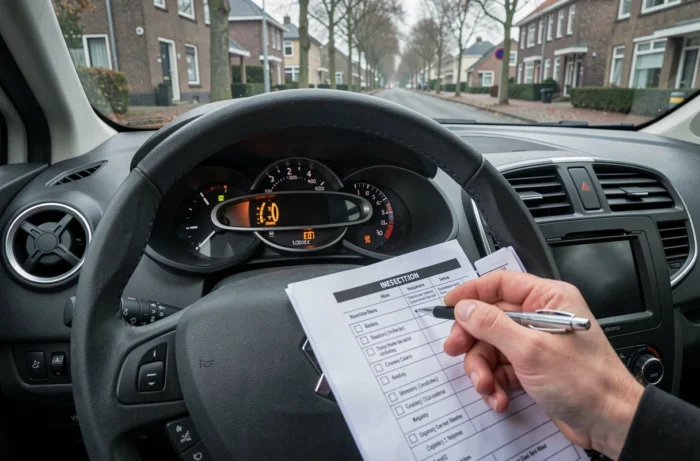
An illuminated engine light on the dashboard does not automatically lead to a refusal, but it draws the inspector’s attention to a potential problem. Have the error codes read by a garage before the visit to avoid unpleasant surprises.
Also think about the windshield: an impact in the driver’s field of vision can lead to a refusal. Cracks that spread from the edge of the glass are often flagged.
Preparing for the technical inspection boils down to three reflexes: check what is visible (lighting, tires, plates), what is measurable (braking, levels), and what is readable (documents). The majority of re-inspections concern defects that can be corrected in less than an hour. With the Flemish reform in September 2026, the choice of region and scheduling the appointment also become parameters to integrate into your preparation.