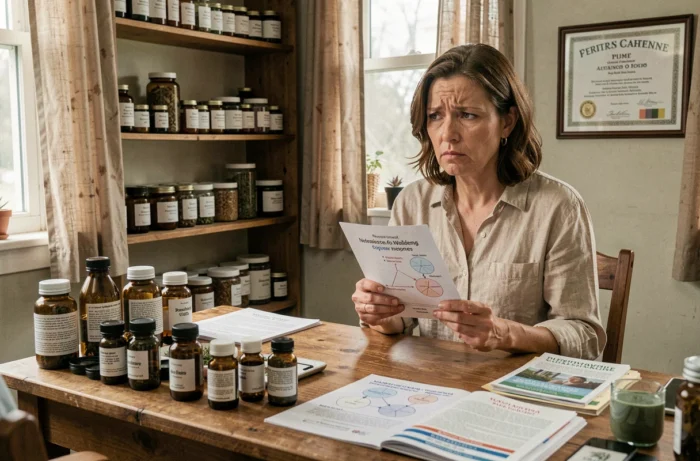
A colleague returning from work with a bottle of “detox” drops prescribed by a “holistic therapist” met on Instagram. A neighbor replacing her hypertension treatment with magnetism sessions. These situations are becoming increasingly common, and they pose a concrete public health problem. Recognizing a dubious therapy before investing time, money, or, worse, risking one’s health, requires some precise reflexes.
Law of May 10, 2024: What has changed for fake therapists in France
Before this law, pursuing a pseudo-therapist was a legal obstacle course. One would encounter generic offenses (illegal practice of medicine, abuse of weakness) that were difficult to characterize in court.
The law of May 10, 2024, creates two distinct offenses. The first targets incitement to abstain from or abandon medical care. The second targets practices presented as therapeutic that expose a person to a risk of death or permanent disability. We move from legal ambiguity to an operational penal framework.
In practical terms, a practitioner who tells you to stop your chemotherapy to follow a vegetable juice protocol can now be specifically prosecuted for that advice. Before 2024, it was necessary to prove sectarian influence or illegal practice of medicine, which took years. This new framework also allows for understanding a dubious therapy based on clear legal criteria rather than just a feeling.
The Miviludes recorded 4,571 reports in 2024, more than double compared to 2015. The health and wellness category represents 37% of these reports. The increase is not anecdotal: it reflects both a better reporting capacity and a real multiplication of practitioners without recognized training.

Concrete warning signs when facing a dubious therapist
On the ground, a therapeutic drift is identified not by the discipline practiced, but by the behavior of the practitioner. A qualified osteopath can go off track, while an unqualified naturopath can stay within the bounds of complementarity. It’s the posture that matters.
Requests that should trigger an immediate refusal
- Stop an ongoing medical treatment: no competent complementary medicine practitioner will ever ask you to interrupt a treatment prescribed by a doctor. If you are asked to do so, leave.
- Cut ties with your loved ones or your primary care physician: patient isolation is a classic mechanism of control, documented in Miviludes reports.
- Pay for sessions in a non-refundable package, often several thousand euros in advance, for a “complete protocol” whose content remains vague.
- Submit to a diagnosis made without clinical examination, solely by “energetic feeling” or “muscle testing.”
Formulations that mask the absence of evidence
We often hear “conventional medicine doesn’t want you to know.” This medical conspiracy rhetoric is a reliable marker. A serious practitioner does not position themselves against medicine; they work in complementarity with it.
Another common formulation: “it works on thousands of patients.” Without published clinical studies, without verifiable data, such claims are worthless. A testimonial is not scientific evidence, even if repeated a hundred times on a website.
Practices targeted by Miviludes: reiki, kinesiology, and paramedical drifts
The latest Miviludes report highlights a marked increase in reports targeting paramedical activities, which represent about 40% of the cases reported. Reiki and kinesiology are explicitly identified as possible drifts, including by the National Council of the Order of Physiotherapists.
The problem is not relaxation or touch per se. It is when a reiki practitioner claims to treat cancer or when a kinesiologist asserts they can detect “traumatic cellular memories” that the red line is crossed. Any practice that substitutes for a medical diagnosis is out of its scope.
Feedback varies on this point: some patients derive real benefits from these approaches in addition to conventional medical follow-up. The distinguishing criterion remains the same. Does the practitioner work with your doctor or against them?

Check a therapist before making an appointment
Before consulting a practitioner of unconventional medicine, one can perform a few quick checks that eliminate the majority of risky profiles.
- Search for the practitioner’s name on the Miviludes website and on the directories of professional orders (doctors, physiotherapists, nurses). A regulated health professional is registered with an order.
- Check the displayed training: a “diploma” issued by a private organization without state recognition does not guarantee any clinical competence. Some naturopathy courses last only a few weekends.
- Ask if the practitioner is willing to communicate with your primary care physician. A refusal is a strong signal.
- Consult online reviews with caution: fake testimonials are common, and a high number of positive reviews does not replace verifiable training.
We are not talking about unnecessary bureaucracy here. These checks take ten minutes and can prevent months of inappropriate care, or even a therapeutic abandonment with serious consequences.
What to do in case of observed drift
If you notice that a loved one or yourself is facing a practitioner who meets the criteria described above, reporting to Miviludes is possible directly online. This report can be anonymous. Health professionals also have a duty to inform about sectarian drifts, as reiterated in the 2024 law.
Reestablishing contact with your primary care physician remains the first concrete action. Even after a treatment interruption, returning for a consultation allows for assessing any potential damage and resuming an appropriate care pathway. The penal framework now exists to protect patients, but the best protection remains a simple reflex: no legitimate therapy asks you to choose between it and medicine.