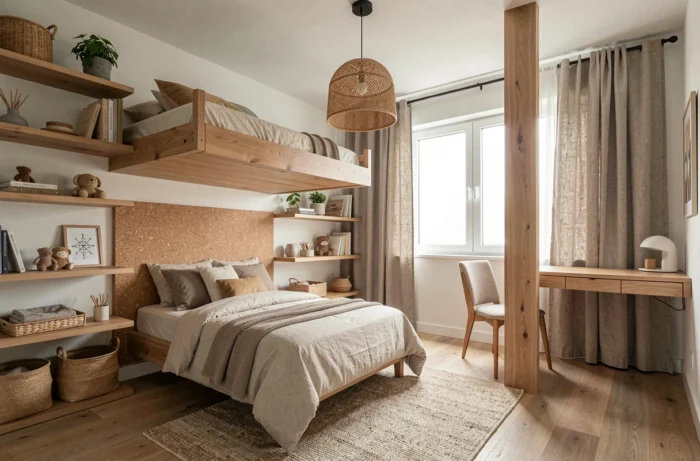
Decorating a modern boy’s room involves making choices about materials, colors, and furniture that directly influence the comfort and durability of the space. Some tips create a strong visual effect for a moderate budget, while others require a heavier investment but last for several years. The following ten suggestions focus on concrete solutions that are comparable and suitable for rooms that need to evolve with the child.
1. Two-tone paint with a low dividing line
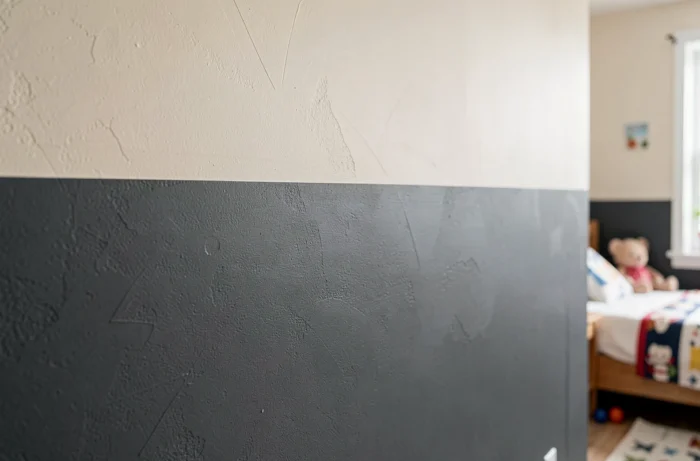
Painting the lower third of the wall in a bold color (sage green, slate blue, terracotta) and leaving the rest in off-white creates visual depth without overwhelming the room. The dividing line, placed between 90 and 110 cm from the floor, roughly follows the height of a child’s headboard.
This technique costs the price of two paint cans and can be redone in a day when tastes change. In contrast, a panoramic wallpaper on the same wall multiplies the budget and complicates touch-ups.
2. Elevated bed compliant with EN 747 standard
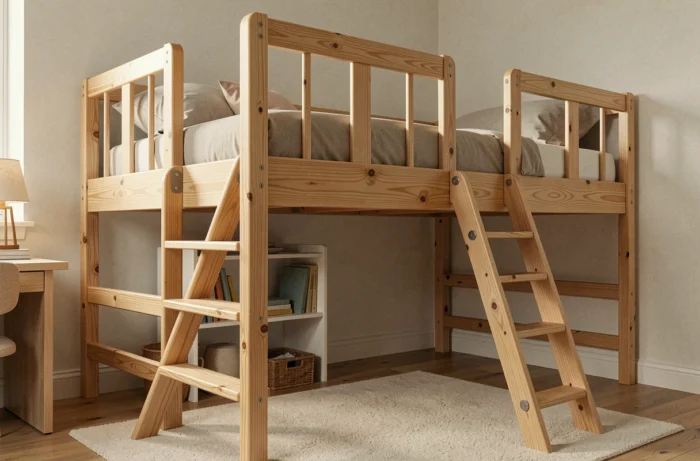
The elevated bed frees up floor space for a desk or reading nook. Before choosing a model for its look, it is essential to check its regulatory compliance. In France, any sleeping surface located 60 cm or more off the ground is regulated by decree no. 95-949 of August 25, 1995, and the EN 747 standard.
The requirements focus on the minimum height of barriers, the maximum thickness of the mattress, and the mandatory mention stating that elevated sleeping surfaces are not suitable for children under six years old. A “low” loft bed is subject to the same regulations as a traditional bunk bed. Checking for these markings on the manual prevents an aesthetically pleasing but non-compliant purchase.
To explore more decor ideas on Read it, this type of technical constraint is regularly discussed in a practical context.
3. Neutral Japanese-inspired palette instead of classic blue
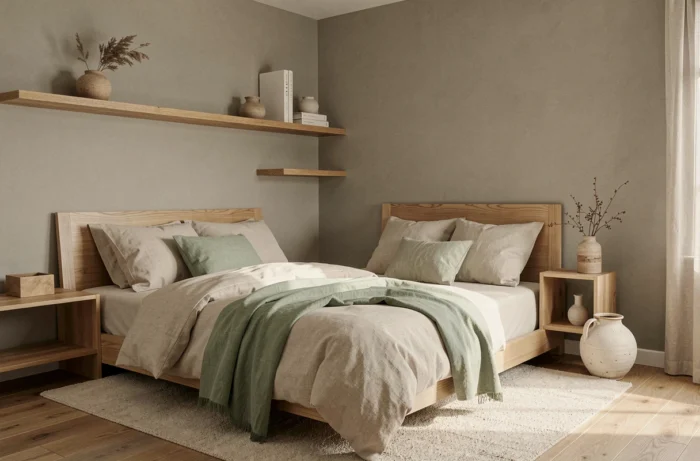
Royal or navy blue remains a common reflex. The trends for 2024-2026 lean towards neutral and textured palettes inspired by Japandi (beige, greige, warm white) enhanced by light wood. These sober bases allow for changing the ambiance with simple textile accessories without repainting.
The measurable advantage: a room designed on a neutral base supports the transition from childhood to adolescence without heavy renovation. The thematic blue, on the other hand, visually dates after a few years.
4. Wooden screen as a separator between desk and sleeping area
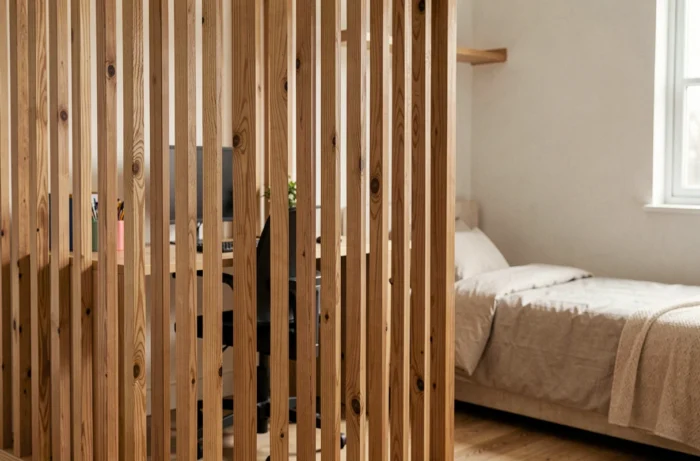
A wooden slat screen (pine, beech) fixed between the desk corner and the sleeping area structures the room without partitioning. Light passes between the slats, and the child perceives two distinct zones within a single room.
The installation is done on a top rail and a bottom rail, without drilling into the ceiling in most configurations. The graphic effect replaces a bulkier separating piece of furniture.
5. Wall storage at child height
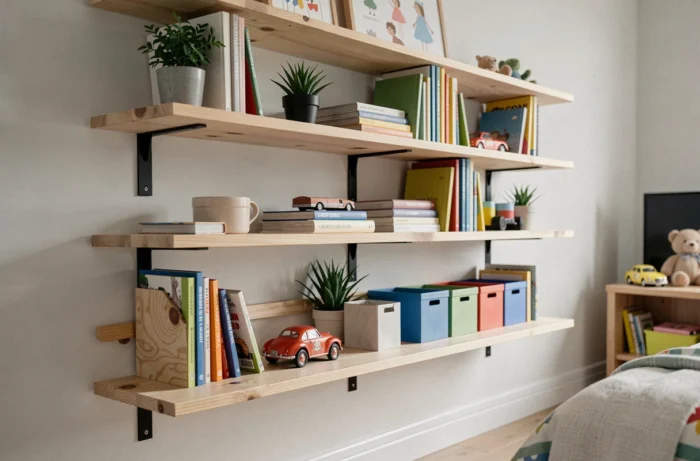
Mounting shelves, hooks, and bins at a height between 60 and 100 cm from the floor makes the child independent in organizing their space. This principle is directly linked to Montessori pedagogy, but its decorative interest is also significant: the displayed objects (books, models, stuffed animals) become an integral part of the decor.
- Shallow U-shaped shelves for books, visible front rather than edge
- Wooden hooks at the child’s shoulder height for bags and caps
- Removable fabric bins on a low metal frame, easy to reposition
6. Headboard made of cork panel
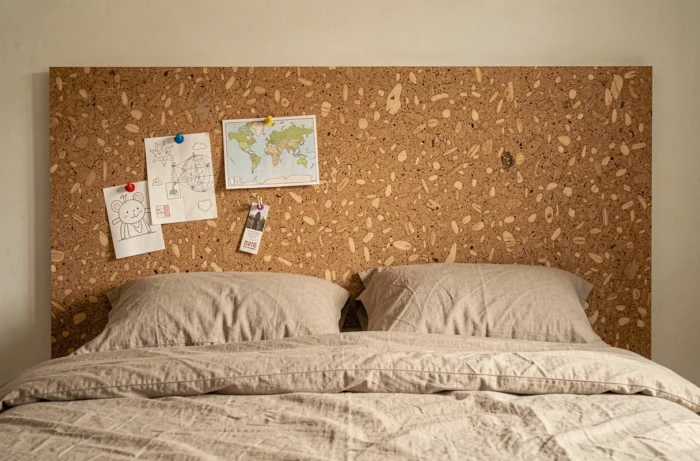
A cork panel cut to the size of the headboard serves two functions. It provides a warm texture and a raw look that fits into modern decor. It also serves as a display surface: drawings, photos, postcards can be pinned without damaging the wall.
The cork absorbs some impact noise, which is an acoustic bonus in a child’s room. The material is easily replaceable when it becomes too punctured.
7. Pendant light in rattan or natural fiber
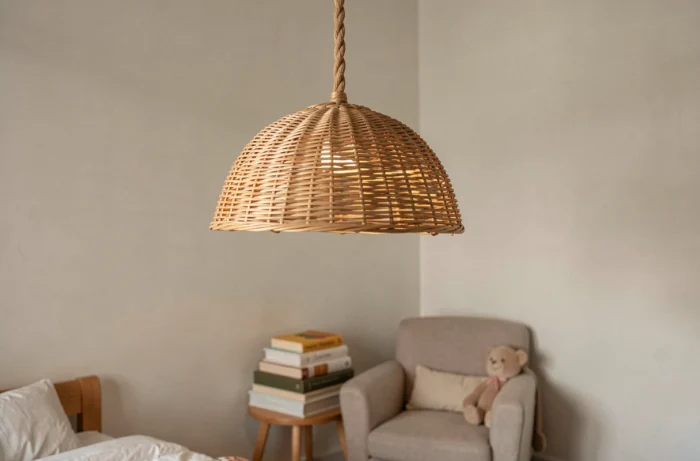
Pendant lights made of natural fiber (rattan, bamboo, wicker) cast graphic shadows on the walls and ceiling, transforming the room’s ambiance as night falls. This type of lighting pairs well with a neutral palette or Scandinavian style.
Opt for a warm temperature bulb (around 2700 K) so that the light filtered through the fibers remains enveloping. A dimmer switch allows for transitioning from play lighting to bedtime lighting.
8. Vinyl flooring that mimics wood instead of parquet
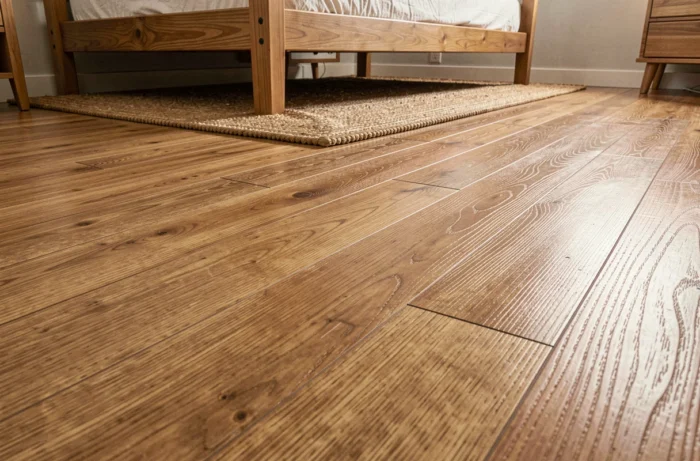
Solid wood flooring is attractive but vulnerable to toy impacts and spilled liquids. A clickable vinyl floor faithfully imitates light wood, is water-resistant, and can be cleaned with a sponge. The floating installation requires no glue or heavy intervention.
Replacing a damaged plank can be done individually. For a child’s room, this compromise between wood aesthetics and practical durability proves to be more lasting than low-quality laminate, whose decorative layer chips under repeated impacts.
9. Low-voltage fairy lights on the headboard
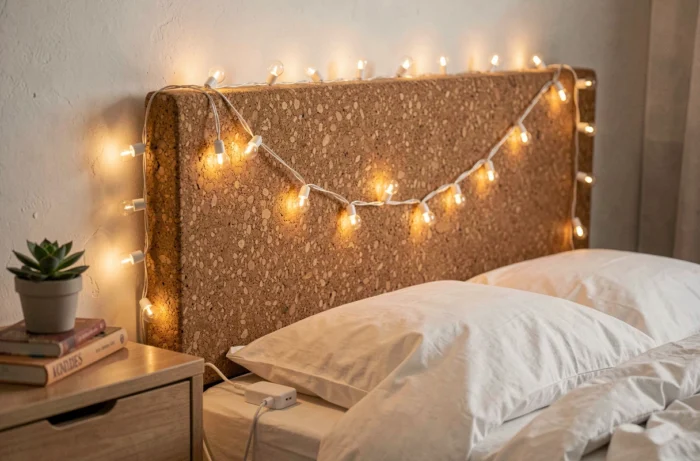
A low-voltage LED garland fixed along the headboard or adjacent wall replaces the classic nightlight. The decorative effect is immediate, and the electricity consumption remains negligible.
Low voltage (often powered by an external transformer) reduces electrical risk in a sleeping area. Choosing micro-LEDs on copper wire rather than plastic balls provides a cleaner look, consistent with a modern boy’s room.
10. Coordinated linen-cotton textiles for duvet cover and curtains
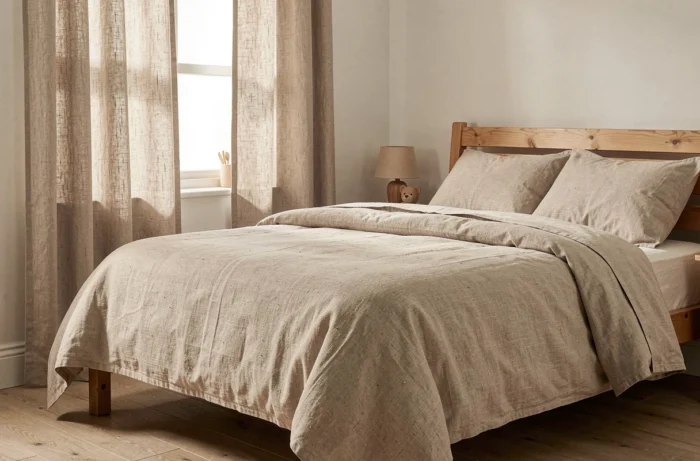
Coordinating the duvet cover and curtains in the same linen-cotton blend (natural shades, greige or khaki) visually unifies the room without resorting to a dated decorative theme. Linen adds texture, while cotton ensures softness during washing.
- Washed linen-cotton duvet cover, natural crumpled look that requires no ironing
- Semi-blackout curtains in the same fabric, lined to filter morning light
- An accent cushion in a bolder color (rust, petrol blue) to break the monotony
This textile choice evolves easily: replacing the cushion or adding a throw is enough to refresh the ambiance without touching the main pieces. A boy’s room built on neutral bases and durable materials ages better than a decor fixed around a character or a single color code.