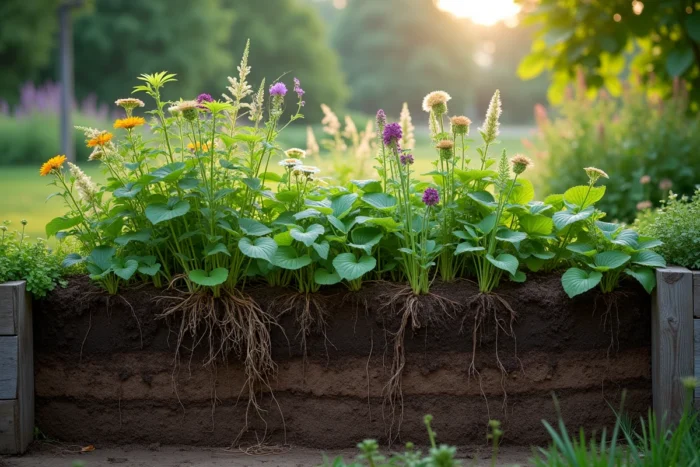
Some plants drive their roots well beyond the first centimeters of soil. This deep underground network improves soil structure, captures water at depth, and, less known, traps carbon in horizons where it remains stable for a long time. Here are ten garden plants with deep roots ranked according to their ability to regenerate tired soil, resist drought, and integrate into a garden without causing nuisances.
The selection is based on three criteria: the effective depth of the root system, the measurable effect on the soil (aeration, fertility, water retention), and the ease of cultivation in the French temperate climate.
1. Alfalfa (Medicago sativa)
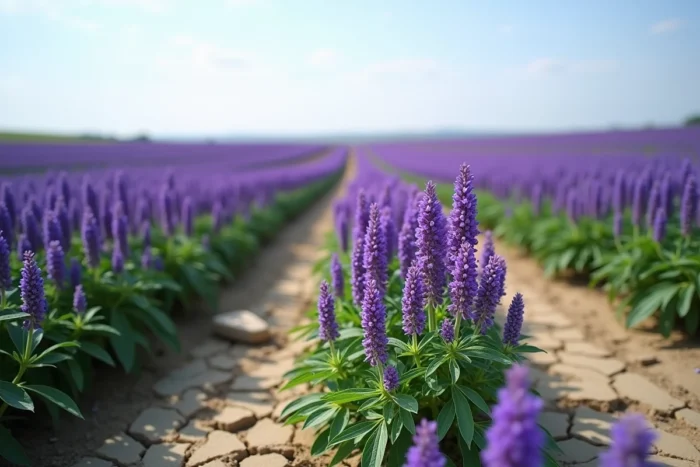
Alfalfa is the champion in every category. Its taproot commonly descends several meters below the surface. It seeks water where most plants never penetrate.
Like all legumes, it fixes atmospheric nitrogen in the soil thanks to its root nodules. A soil after three years of alfalfa is more friable, better drained, and significantly richer in organic matter. This is why farmers use it as a cover crop for regeneration between two crops.
In the garden, sow it on a tired plot of the vegetable garden and let it work for an entire season before mowing and incorporating the biomass.
2. Common Comfrey (Symphytum officinale)
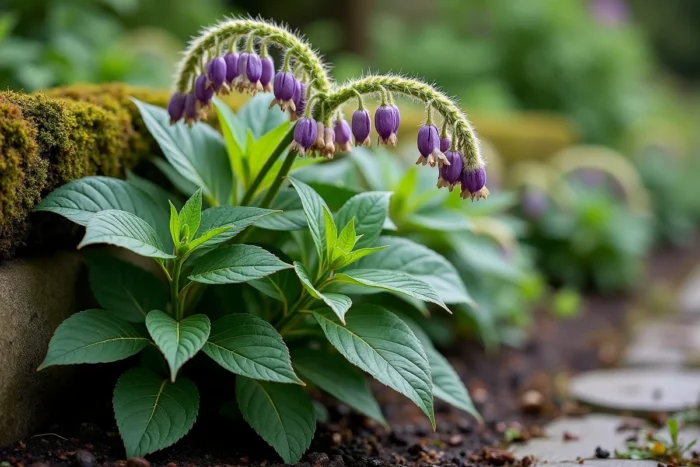
Have you ever noticed those broad hairy leaves that regrow even when cut back? That’s comfrey. Its roots dive deep to bring up surface minerals inaccessible to neighboring plants, notably potash and boron.
The cut leaves serve as a nutritious mulch or fertilizing liquid manure. It’s a living nutrient pump. Plant it at the edge of the vegetable garden: it requires neither regular watering nor rich soil to thrive.
To learn more about garden plants with deep roots, comfrey is one of the most documented species for its beneficial effect on the underground life of the soil.
3. Sessile Oak (Quercus petraea)
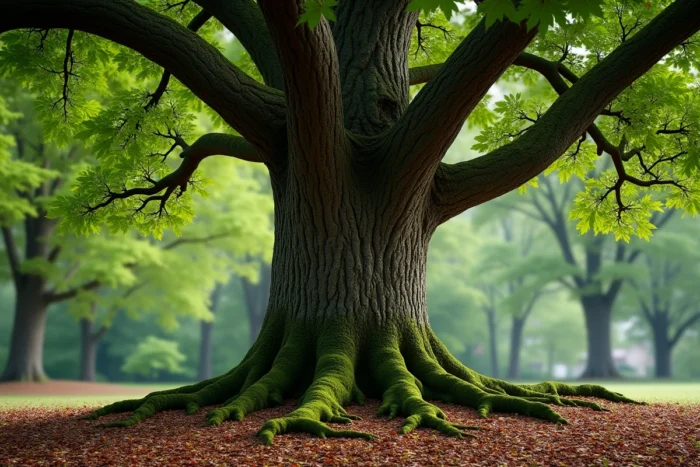
A tree in a ranking of garden plants? The sessile oak deserves its place because its taproot reaches considerable depths, sometimes beyond what most fruit trees achieve.
Its root network structures the soil over the long term. The fallen leaves slightly acidify the surface soil, which encourages a whole array of mycorrhizal fungi. These fungi, in turn, improve water and phosphorus absorption for neighboring plants.
It requires a large area and patience. A mature sessile oak forms a majestic canopy, but it is not suitable for a small urban garden.
4. Sainfoin (Onobrychis viciifolia)
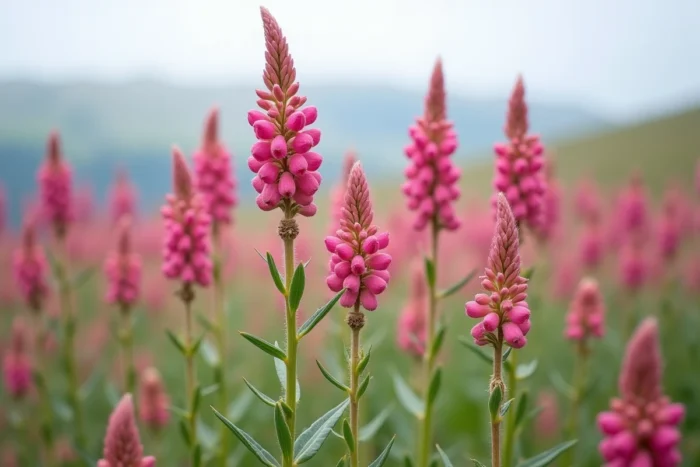
Less known than alfalfa, sainfoin deserves the attention of gardeners concerned about their soil. Its taproot descends deeply even in compact limestone soil, where many other plants struggle.
Like alfalfa, it fixes nitrogen. Its bright pink flowers attract a lot of pollinators, making it an ally for the vegetable garden and orchard. Sainfoin grows without irrigation on well-drained and poor soils, exactly where it is most useful.
5. Wild Chicory (Cichorium intybus)
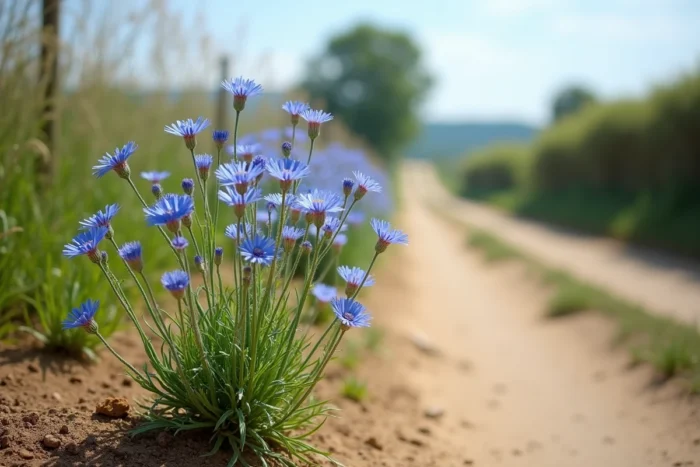
This perennial with blue flowers found along paths has an surprisingly long taproot. It breaks through compacted layers and creates channels where water and air circulate after its decomposition.
In the vegetable garden, it serves as green manure in intercropping. In meadows, it diversifies the cover and improves soil porosity. Little demanding on water, it withstands full sun and poor soils.
6. Common Fig (Ficus carica)
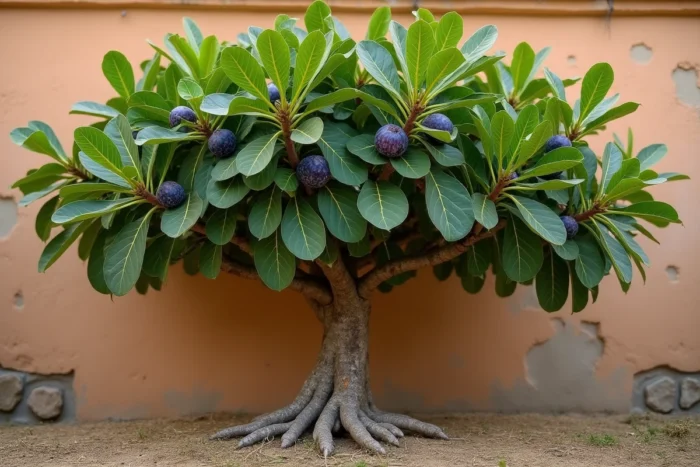
The fig tree develops a powerful root system that explores the soil deeply and widely. This ability allows it to withstand prolonged droughts without watering.
Be careful with planting: its roots can cause problems near pipes or foundations. Plant the fig tree away from underground infrastructures, ideally several meters from any network. In return, it remarkably structures the soil around it and produces delicious fruits in a warm temperate climate.
7. True Lavender (Lavandula angustifolia)
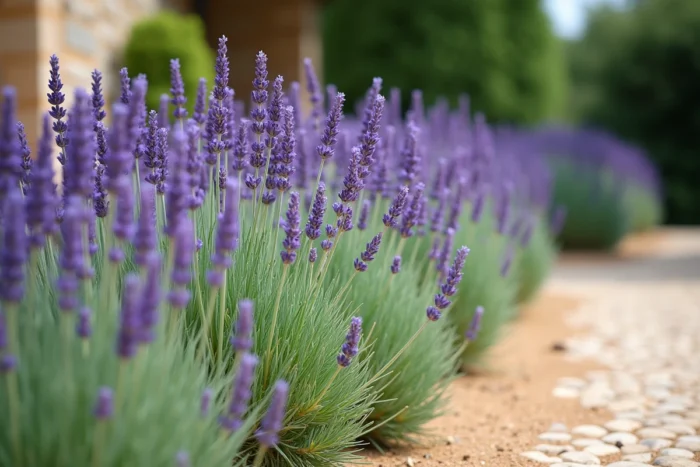
Lavender does not immediately come to mind when talking about deep roots. However, its taproot descends enough to seek residual moisture in well-drained and stony Mediterranean-type soils.
It does not improve fertility like a legume, but it maintains the cohesion of sloping soil and limits erosion on dry, sun-exposed terrains. Its prolonged flowering nourishes bees for a good part of the summer.
8. Giant Miscanthus (Miscanthus x giganteus)
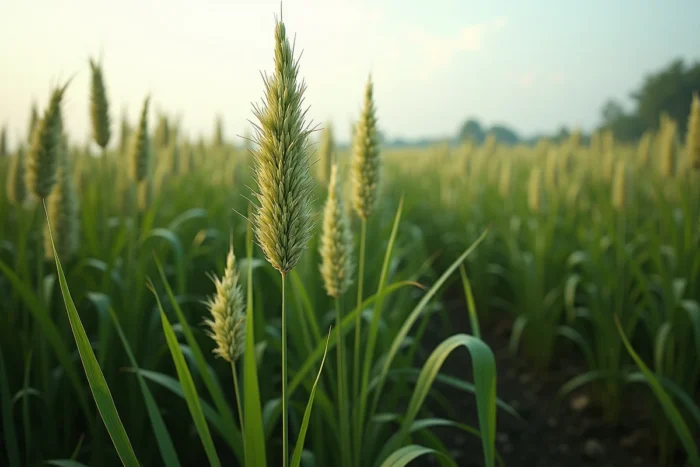
This ornamental grass produces dense roots that extend well beyond the topsoil. Miscanthus is used in agriculture as a biomass crop, but in the garden, it serves as a windbreak, free hedge, or plant screen.
Its interest for the soil lies in two things:
- Its roots create a very dense underground network that aerates compacted horizons over the seasons.
- The abundant aerial biomass, once mowed and left on the ground, nourishes earthworms and microorganisms.
- Cirad emphasizes that deep and widely branched root systems like that of miscanthus contribute to carbon storage in the deep horizons of the soil.
9. Dandelion (Taraxacum officinale)
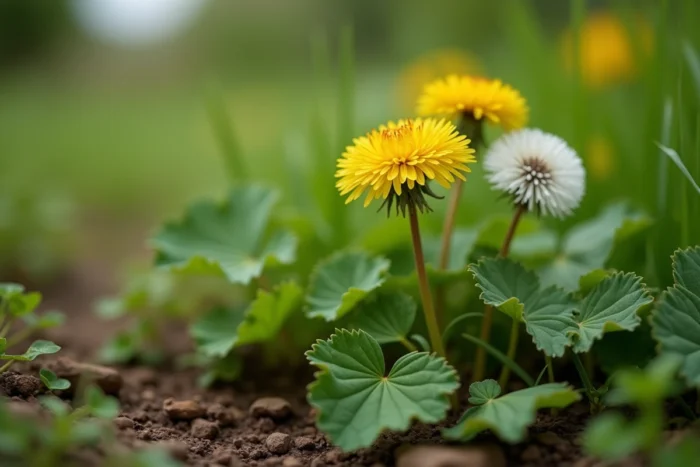
The dandelion is often pulled out as a weed. This is a mistake when trying to loosen compacted soil. Its taproot pierces hard layers and, as it decomposes, leaves vertical galleries that facilitate water infiltration.
Its leaves are edible, and its early flowering nourishes the first spring pollinators. Rather than eliminating it, let it colonize the most compacted areas of your land. Once the soil is softened, other plants will naturally take over.
10. Common Vetch (Vicia sativa)
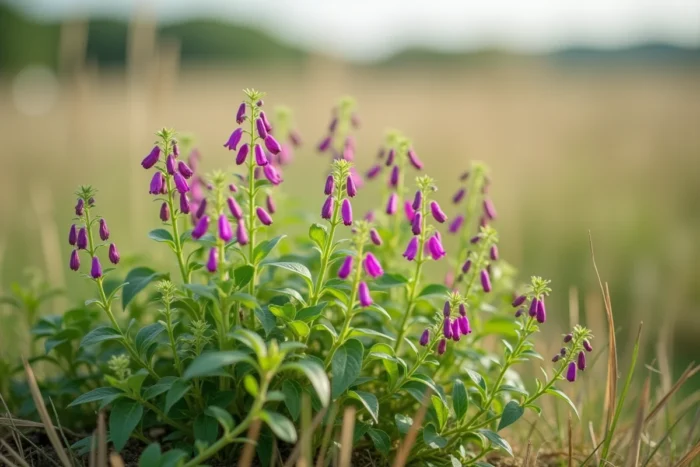
Vetch is the green manure par excellence for small gardens. Its roots descend sufficiently to improve the soil structure below the layer worked by the spade. Like alfalfa and sainfoin, it fixes atmospheric nitrogen.
Sown in autumn, it covers the soil during winter, prevents nutrient leaching from rain, and is mowed in spring before sowing. A cycle of winter vetch is enough to restart the biological activity of an exhausted plot.
All these plants share a common point: they work the soil deeply, where neither the spade nor the tiller can reach. Combining two or three species from this list in the same plot accelerates regeneration. The soil gains in porosity, fertility, and water retention capacity, three qualities that then benefit everything you plant.