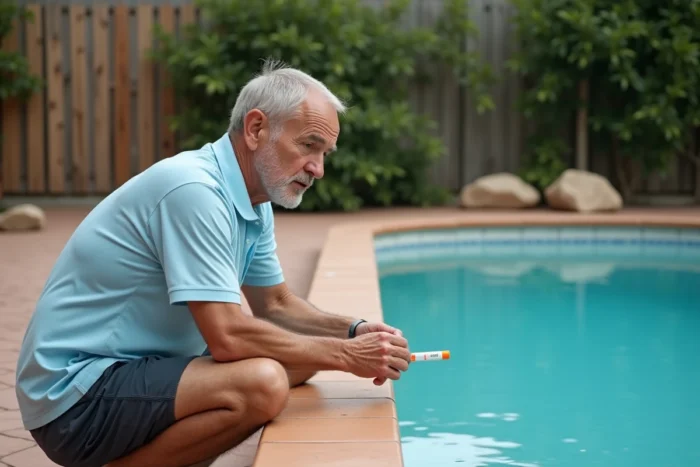
Saltwater pools treated by electrolysis share a common trait: their pH tends to rise naturally. This phenomenon, linked to the very process of chlorine production by the electrolysis cell, places these pools in a different situation compared to a traditional chlorine pool. Understanding why this imbalance occurs and what it concretely causes on the water, equipment, and comfort of bathers helps avoid a cascade of often misidentified problems.
Electrolysis Cell and pH Drift: A Mechanism Specific to Saltwater Pools
In a saltwater pool, the electrolysis cell transforms dissolved salt (sodium chloride) into active chlorine. This reaction simultaneously produces soda (sodium hydroxide), a strongly alkaline compound. With each cycle of chlorine production, the pH of the water mechanically rises.
This is a fundamental difference from a pool treated with chlorine tablets or liquid: here, the production of disinfectant itself generates the rise in pH. Saltwater pool owners often notice that their pH rises just a few hours after correction, without understanding that the electrolyzer is the direct cause.
This cycle is reinforced in hot weather when filtration runs longer and the cell operates more. In summer, the drift can reach several tenths of a point in a single day. When a high pH in a saltwater pool persists despite regular additions of corrector, the cause is rarely just a simple dosing oversight.
Clogging of the Electrolyzer: The Consequence That General Guides Omit
A pH that exceeds the range of 7.2 to 7.4 does not just reduce the effectiveness of chlorine. In a saltwater pool, it causes a specific phenomenon: calcium precipitates directly on the plates of the electrolysis cell.
These limescale deposits form an insulating layer on the electrodes. The cell then has to work harder to produce the same amount of chlorine, which accelerates its wear. In practice, an electrolyzer operating with a chronically high pH will see its lifespan significantly shortened.
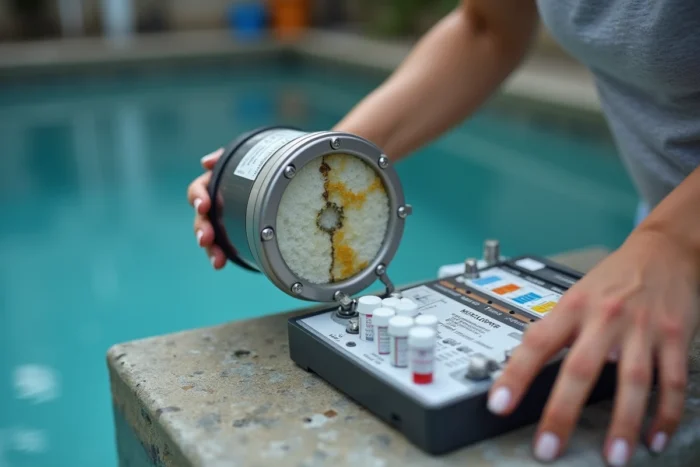
The vicious circle is formidable: the pH rises, limescale deposits, chlorine production decreases, algae appear, and the owner increases the operating time of the cell, which further raises the pH. Breaking this loop requires upstream control, not downstream correction.
The Role of TAC in a Reluctant pH
Correcting the pH with a pH minus product, noticing that it decreases, and then observing that it rises again within a few hours: this frustrating scenario often has a precise chemical explanation. A TAC that is too high locks the pH upwards, even after correction.
TAC (total alkalinity) measures the buffering capacity of the water, meaning its resistance to pH variations. When this alkalinity is too high, the water absorbs the acidic corrector without the pH moving sustainably. Competing guides treat pH and TAC separately, as two independent parameters. In reality, they form an inseparable pair.
The strategy then changes radically:
- Measure the TAC before any intervention on the pH. If the TAC exceeds the recommended range, it is the first thing to lower.
- Use an appropriate acid (sodium bisulfate or diluted hydrochloric acid) in fractional doses, with a delay of several hours between each addition.
- Only retest the pH after stabilizing the TAC, to avoid multiplying unnecessary corrections and further destabilizing the chemical balance.
Field reports vary on the time required to stabilize excessive TAC. Some pools regain balance in a few days, while others require weeks of gradual corrections, depending on the hardness of the fill water and the volume of the pool.
Bathing Comfort and High pH: Beyond Red Eyes
Articles on high pH consistently mention eye and skin irritations. These are real symptoms, but the picture is broader than that.
Water with a high pH becomes slippery to the touch, with a texture sometimes described as soapy. This sensation, unpleasant for bathers, indicates marked alkalinity. It is accompanied by skin dryness after swimming, as alkaline water alters the skin’s hydrolipidic film.
User feedback also reports accelerated degradation of swimming accessories (goggles, silicone caps) with prolonged contact with overly alkaline water. Rubber and silicone lose flexibility, and the seals of goggles become porous more quickly.
Cloudy water is another common symptom. Chlorine loses most of its disinfecting power above pH 7.8, allowing microorganisms and fine particles to proliferate. The sand filter clogs faster, the filtration pump works harder, and the pool takes on a milky appearance that even a shock treatment struggles to correct if the pH is not first brought back into the correct range.
Monitoring pH in Saltwater Pools: When and How to Measure Effectively
Weekly spot measurements, often recommended for traditional pools, prove insufficient for a saltwater pool. The drift being continuous and linked to the operation of the electrolyzer, certain triggering events require close monitoring:
- After a hot day when filtration has run for more than ten hours
- After a storm or heavy rain, which alters both pH and TAC
- After adding new water (partial filling), whose pH and hardness may differ significantly from that of the pool water
- After cleaning or descaling the electrolysis cell, which restarts the production of soda at full capacity
An automatic pH regulator remains the most reliable option for saltwater pools, as it continuously injects corrector in proportion to the measured drift. Manual systems require constant vigilance that most owners do not maintain throughout the season.
The available data does not allow for a conclusion that one type of probe (electrochemical or colorimetric) is significantly superior for domestic use. Both technologies work, provided they are regularly calibrated, a detail that many user manuals mention without emphasizing its actual frequency.
The pH of a saltwater pool is not a parameter that is adjusted once a week and forgotten. It is a dynamic indicator, in constant motion, whose management conditions the longevity of the electrolyzer, the quality of disinfection, and the real comfort of bathers.