
You enter your address on a website, provide the surface area and the number of rooms, and thirty seconds later a price appears. This figure, displayed to the nearest cent, gives an impression of certainty. However, the reliability of these online property valuations remains a topic that every seller or buyer should examine before making a decision in 2026.
DPE and energy discount: the blind spot of online estimators
Estimation tools rely on DVF databases, which means the prices actually paid during past transactions. This data is updated only twice a year, in April and October. In the meantime, the market moves.
Since the gradual ban on renting out properties classified as G and then F, an entire segment of the real estate market is experiencing discounts that algorithms struggle to capture. The DVF databases are several months behind actual negotiations and understate the effect of new energy diagnostics.
Specifically, if you estimate an apartment classified as F online, the tool will look for comparable sales in the neighborhood without necessarily isolating those that concern energy-intensive properties. It mixes apples and oranges. Recent sector analyses, particularly from FNAIM, report frequent discrepancies of 15 to 20% on low energy performance properties. The displayed estimate can therefore significantly overvalue a poorly rated property.
A detailed article also examines real estate valuation on bricosuccess-immo.fr according to Trend Immo and highlights this type of discrepancy between estimated price and signed price.
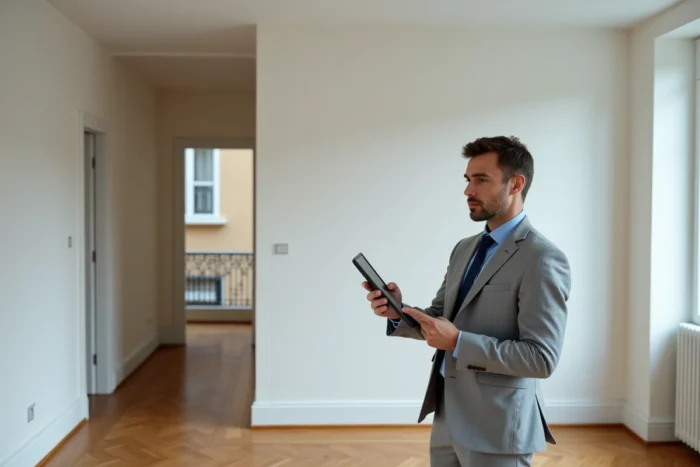
Online property estimation: what the algorithm sees and what it ignores
Have you ever noticed that two estimators can display very different results for the same property? That’s normal, and understanding why helps to better interpret their results.
All serious tools follow a similar principle. They retrieve past transactions within a radius around your address, over a window of six to thirty-six months. Then they adjust based on the surface area, property type, and sometimes a few additional criteria.
Available data
- The address and geolocation, which allow finding comparable sales in the neighborhood or nearby municipality
- The living area and the number of rooms, basic criteria for any square meter calculation
- The average price per square meter by sector, derived from notarial and DVF databases
Missing or poorly captured data
- The actual condition of the property: a newly renovated apartment and a property needing renovation in the same building do not have the same value, but the algorithm does not visit
- The floor, exposure, brightness, view, presence of an elevator: all criteria that weigh heavily in the final price but that free tools incorporate little or not at all
- Approved or upcoming co-ownership works, a façade renovation, a roof replacement, which can change the value by several thousand euros
- The micro-local context: a quiet street versus a busy street, a facing property, proximity to a noise nuisance
The algorithm calculates a statistical average, not the value of your specific property. This is the fundamental distinction to keep in mind.
Input errors and price range: two concrete traps
The first factor of discrepancy between online estimation and reality is not technological. Case studies on recent sales identify input errors as the primary cause of the gap between estimation and actual value. An incorrectly reported surface area, a garage counted as a living room, an erroneous floor: every approximation in the form affects the result.
The second trap is the false precision of the displayed figure. An estimator that indicates 327,400 euros gives the impression of a calculation to the cent, whereas the actual margin of error ranges from a few percent to over 20% depending on the situations. For a standard property in a dense urban area, the best models remain relatively close to the signed price. For an atypical property, in a rural area or in a little active micro-market, the gap widens significantly.
Why this discrepancy? Because the algorithm needs a sufficient volume of comparable sales to produce a reliable result. In a municipality where only a few transactions have taken place in the last twelve months, the analysis radius widens, along with the heterogeneity of the compared properties.

Using an online estimation tool without making mistakes
Online estimation is not useless. It provides a quick and free ballpark figure that helps you gauge the market before going further. The problem arises when this figure becomes the sale price displayed in the listing, without verification.
Always compare several tools for the same property. If the results converge, the obtained range has a certain coherence. If the discrepancies between estimators exceed ten percent, it’s a signal: your property likely has characteristics that algorithms struggle to model.
The next step remains the intervention of a professional, real estate agent or notary, who visits the property, assesses its actual condition, incorporates the DPE and the specifics of the neighborhood. On-site estimation transforms a statistical range into a defendable price.
A good reflex is also to directly consult the DVF database via the Patrim site of the tax administration. You will find the prices actually paid in your street, without algorithmic filtering. This raw data, cross-referenced with the online estimate and the opinion of a professional, forms a solid foundation for setting a sale price consistent with the real estate market of 2026.