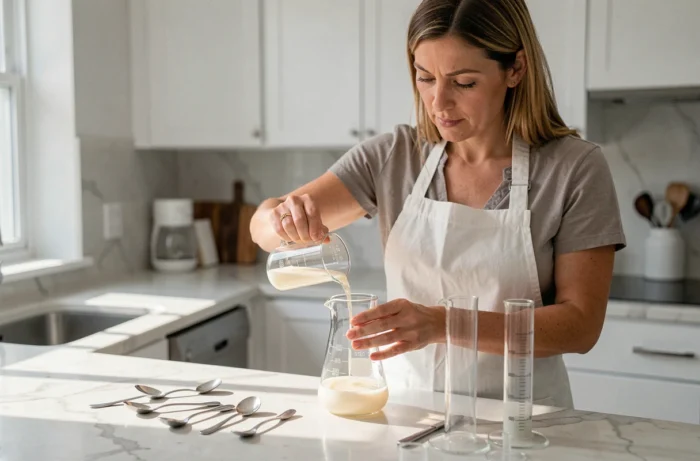
We take a brick of cream out of the fridge: 20 cl. The clafoutis recipe found online calls for 200 ml of milk. The measuring cup displays both scales, but not at the same graduations. This confusion between centiliters and milliliters slows down the preparation and, above all, can distort the proportions of a pastry or a cocktail measured to the nearest milliliter.
Conversion cl to ml with everyday containers
Most articles on the subject provide a conversion table. The problem is that we don’t cook with a table in front of us. We have a yogurt pot, a mustard glass, a coffee cup. The reflex to develop is physical, not mathematical.
A standard yogurt pot contains about 125 ml, or 12.5 cl. A classic coffee cup is around 100 ml (10 cl). A common mustard glass is about 200 ml (20 cl). These references are sufficient for most everyday recipes.
When a recipe indicates 15 cl of milk, we know we are aiming for a yogurt pot plus a small splash. When it asks for 50 ml of rum for a baba, that’s half a coffee cup. We can quickly convert cl to ml by relying on these familiar volumes rather than counting zeros.
Associating each container with its volume avoids taking out the measuring cup for common measurements. Feedback varies on the exact capacity of a mustard glass depending on the brands, but the order of magnitude remains reliable for a soup or pancake batter.
Conversion errors cl/ml: the concrete pitfalls in the kitchen

Multiplying or dividing by 10, everyone knows the rule. Errors almost never come from the calculation itself. They come from the context in which we apply it.
Confusing volume and weight on the measuring cup
Many measuring cups display a scale in milliliters and another in grams. For water, the two coincide: 100 ml weighs 100 g. For flour, oil, or honey, this is false. Pouring 100 ml of oil does not yield 100 g of oil.
The conversion cl/ml concerns only volume, never weight. When a recipe mixes the two (“20 cl of cream, 150 g of sugar”), we apply the rule only to liquids. Sugar, we weigh.
The disappearing decimals
Converting from 2.5 cl to ml gives 25 ml, not 250 ml. The classic error is to add an extra zero when the starting number contains a decimal. The safe reflex: mentally move the decimal point one place to the right.
- 2.5 cl → 25 ml (decimal moved one position)
- 0.5 cl → 5 ml (we do not multiply 0.5 by 100)
- 33 cl (standard can) → 330 ml, not 33 ml or 3,300 ml
This mechanism also works in the other direction. To convert from 750 ml to cl, we move the decimal point to the left: 75.0 cl.
Reading the wrong line on a package
Bricks of milk or cream often display the capacity in cl on the front and in ml in the nutritional table (per 100 ml). We think we are reading the total volume when we are reading the basis for nutritional calculation. Checking the unit before pouring takes two seconds and avoids doubling a dose.
Quick method to convert cl to ml in your head
As mentioned, the rule boils down to one operation: 1 cl equals 10 ml, we multiply by 10. But in real situations, especially when our hands are in the dough, here’s how to make this calculation even smoother.

Instead of thinking “multiplication,” we think “adding a zero.” If the recipe says 5 cl, we mentally write 50 ml. If it says 25 cl, we see 250 ml. This visual reflex is faster than a calculation because it does not engage the same area of attention.
For the reverse, ml to cl, we remove a zero. 300 ml becomes 30 cl. Removing a zero to convert from ml to cl works every time, as long as the number is round. When it’s not (175 ml, for example), we divide by 10: 17.5 cl.
The link between milliliters and cubic centimeters
A point rarely addressed in recipes but useful for understanding why the conversion is fixed: 1 ml corresponds exactly to 1 cm³. This is not an approximation. The metric system was designed so that these two measurements coincide perfectly.
In practice, this means that a container whose volume is known in cubic centimeters gives the volume in milliliters directly. A cake mold of 1,500 cm³ contains 1,500 ml, or 150 cl, or 1.5 liters. We switch from one unit to another without a correction factor.
Adapting liquid measurements according to the type of recipe
Not all recipes require the same precision. A soup easily tolerates a deviation of 20 ml on the broth. A pastry, much less.
- Soups, stews, long sauces: measuring by container (glass, cup) is sufficient. A deviation of a few cl does not change the result.
- Pastry, creams, ganaches: a graduated measuring cup in ml is preferable. Precision within 5 ml influences the texture.
- Cocktails, syrups, French press: recipes often give doses in cl. Converting to ml makes it easier to read the measure, especially under 10 cl.
In pastry, when unsure between 15 cl and 150 ml of liquid cream, the conversion confirms that it’s the same quantity. Checking the correspondence before pouring avoids doubling or halving a dose by mistake.
The last common pitfall concerns recipes translated from English. American “cups” do not correspond to either round cl or ml (one cup is about 237 ml). When encountering this case, it’s better to first convert the cup to ml, then possibly to cl, rather than looking for a direct cup/cl equivalence that does not properly exist.
The conversion cl/ml remains one of the simplest in the metric system. Remembering that we add or remove a zero covers almost all situations in the kitchen. For more precise cases, the reflex of the familiar container (yogurt pot, mustard glass, cup) takes over without calculation. The real time-saving is not knowing the formula, but no longer hesitating at the moment of pouring.