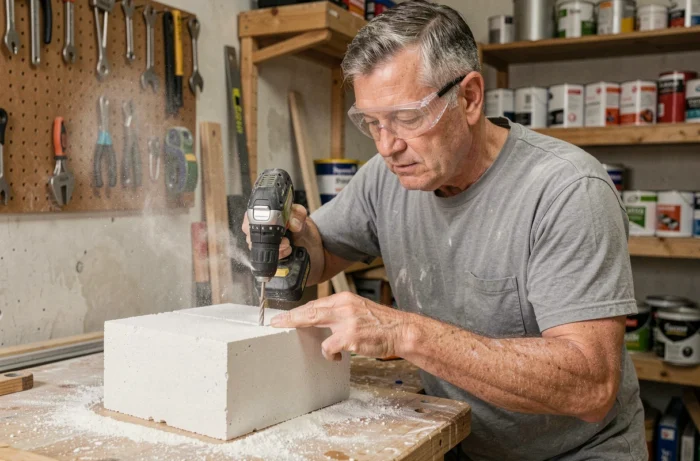
Cellular concrete cannot be drilled like a concrete block or a solid brick. Its cellular structure, which contributes to its lightness and insulating properties, requires a drilling protocol that is radically different from that applied to dense masonry. Any error in adjustment or choice of drill bit results in a flared hole, a plug that spins in empty space, and, in the worst case, a breakthrough on a thin partition.
Rotation only and moderate speed: the adjustment that changes everything
The non-negotiable rule for cellular concrete is to systematically disable the percussion. A cellular material absorbs impacts by disintegrating: the strike creates radial micro-cracks around the hole, irregularly enlarges the diameter, and compromises the hold of any subsequent fastening.
We recommend a standard drill-driver or a hammer drill set to pure rotation mode. The rotation speed should remain moderate: too high a speed heats the bit, vitrifies the surface, and produces a hole with crumbly edges. A controlled torque allows the bit to bite gradually without jolting.
For those who want to drill cellular concrete easily without having to redo a failed hole, this adjustment is the starting point, well before choosing the drill bit.
Cellular concrete drill bit and hole sizing for heavy loads
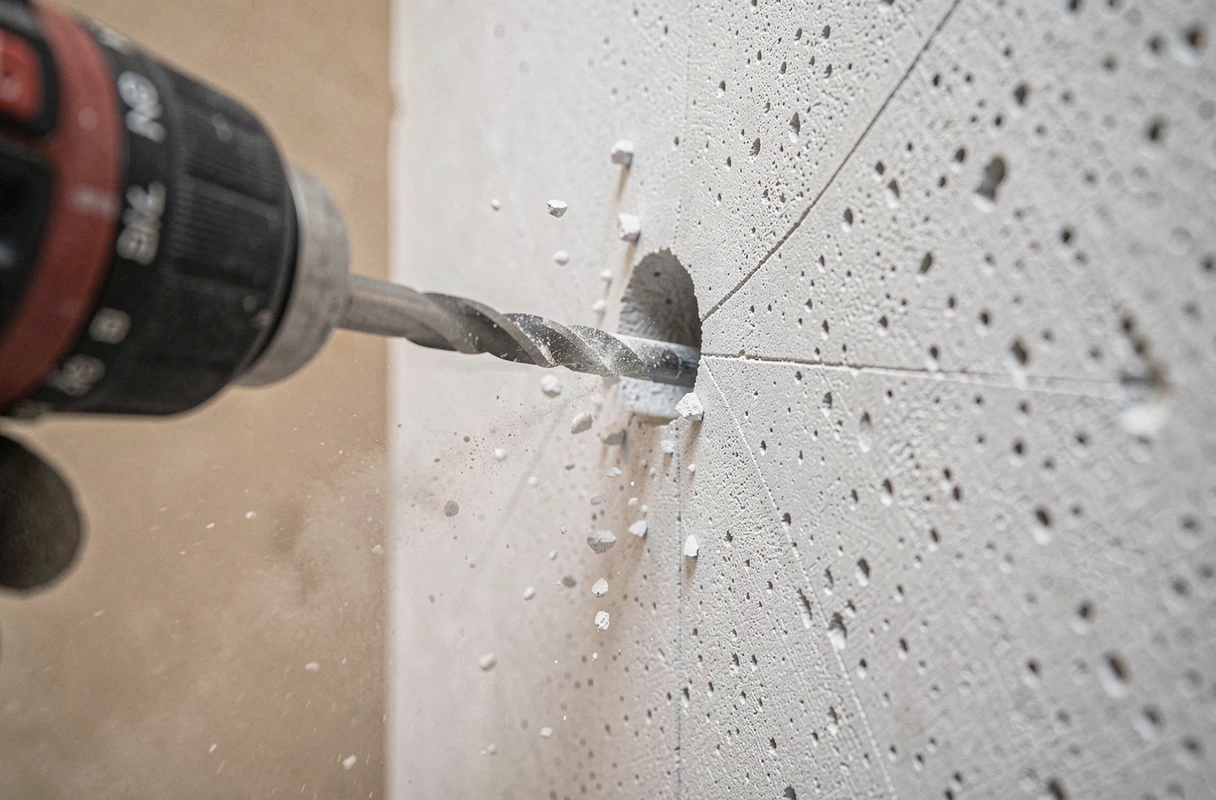
The universal tungsten carbide bit is suitable for standard drilling. However, as soon as the fastening must support a medium or heavy load (high kitchen cabinet, water heater, TV mount), the diameter of the bit must exactly match that of the plug, without oversizing.
Oversizing the hole in cellular concrete is the primary source of failure. On a concrete block wall, half a millimeter of play can be compensated by tightening the plug. On a cellular material, this play prevents the plug’s fins from anchoring in sufficiently dense material. Therefore, the bit must be strictly calibrated.
Specific plugs for cellular support
Standard expansion plugs do not work in cellular concrete. They exert radial pressure that causes the cells to burst without generating resistance to pull-out. We systematically use plugs designed for hollow or cellular materials, recognizable by their spiral fins or twisted nylon body that screws into the material.
- Nylon screw plug for light to medium loads: it screws directly in and distributes the effort over a large surface of cells
- Metal plug with controlled expansion for medium loads: its expansion remains limited to avoid fracturing the block
- Chemical anchoring for heavy loads: a resin injected into the hole fills the cells, creates a monolithic anchor, and offers the best pull-out resistance on this type of support
Chemical anchoring requires a perfectly dust-free hole. Without prior cleaning, the resin adheres to the dust rather than the material, significantly reducing its hold.
Edge distance and partition thickness: the limits not to be exceeded
On a thin cellular concrete partition, the issue is not only to drill cleanly but also to preserve the structural integrity of the block. The distance between the edge of the hole and the edge of the block must respect a minimum proportional to the diameter of the fastening; otherwise, the material may crack or pull out in a cone shape.
We regularly observe pull-outs on thin partitions when the fastening is placed too close to a corner or edge. Cellular concrete does not redistribute stresses like solid concrete: the crack propagates along the cells according to a line of least resistance, often diagonally.
Multi-pass drilling on thin partition
On a partition whose thickness does not exceed the length of the plug, multi-pass drilling with a smaller bit, followed by a bit of the final diameter, limits vibrations transmitted to the block and reduces the risk of breakout at the exit.
- First pass with a smaller diameter bit, at slow rotation, to create a guide
- Second pass with the final diameter, without forcing, allowing the bit to work
- Vacuuming or blowing out dust before inserting the plug or injecting resin
This two-pass protocol adds a few seconds per hole but avoids the need to fill and relocate a fastening point.

Cleaning the hole before fastening: a step often neglected
Cellular concrete generates fine, light dust that remains in the hole by capillarity. Unlike traditional concrete dust, it does not fall out naturally. Vacuuming or blowing out each hole before inserting the plug is an essential step, especially before chemical anchoring.
An uncleaned hole gives a false impression of solidity during tightening. The plug seems to hold, but the compressed dust gradually settles under the load, creating play that eventually causes movement of the fastening.
We use an air bulb or a workshop vacuum equipped with a fine nozzle. A brush, sometimes recommended, can widen the hole on such a soft material, especially on diameters over eight millimeters.
Drilling cellular concrete without damage relies on three interdependent technical choices: rotation without percussion, bit of exact diameter, and plug suitable for cellular support. On a thin partition intended to support a load, chemical anchoring in a properly dust-free hole remains the most reliable fastening. Any simplification on one of these three points will compromise the lifespan of the assembly.