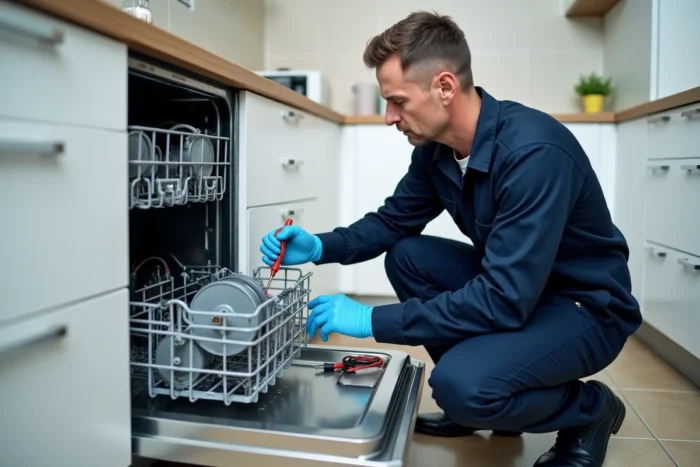
The water supply tap is closed, the Bosch dishwasher is unplugged, and yet the E15 code appears again after two cycles without any issues. We dried the bottom tray, restarted the machine, everything seemed resolved. Three days later, here we go again. This scenario of intermittent leakage is the most frustrating to diagnose because it leaves no visible trace on the floor.
Intermittent leak and recurring E15 code: the phantom failure of the Bosch dishwasher
The E15 code indicates the activation of the AquaStop system, meaning water has been detected in the bottom tray (the base under the tub). When we tilt the machine and soak up this water, the float drops back down, and the error disappears. The temptation is strong to consider the problem resolved.
On the ground, feedback shows that the E15 that disappears and then reappears indicates an intermittent leak, not a false positive. Water only accumulates when certain conditions are met: high water pressure, long cycle at high temperature, specific vibrations. The bottom tray sometimes takes several cycles to fill sufficiently for the float to trigger the alert.
When facing a recurring E15 fault on a Bosch dishwasher, the only reliable method is to identify the exact source of the micro-leak before restarting the appliance.
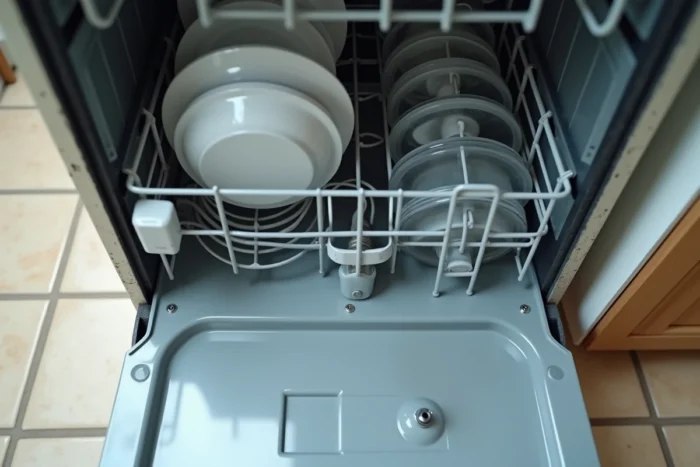
Locating the leak in the base of the Bosch dishwasher
Before any intervention, we cut the power supply and close the water tap. We pull the machine out of its location to access the base from underneath or from the back.
Remove the bottom plate
The majority of built-in Bosch models have a protective plate under the base, secured by a few screws. Once removed, we access the bottom tray, the AquaStop float, and the components that may leak. We soak up any residual water and carefully dry the tray.
Identify the wet area in the next cycle
We place absorbent paper or towels in strategic locations under the machine, then we start a short cycle with the plate removed (machine placed on a protected surface). Areas to monitor:
- The connection of the water supply hose to the solenoid valve, often located at the back left. A worn or misaligned seal causes a leak that is only visible under pressure.
- The clamps of the drain hose and the internal circuit connecting the tub to the pump. A loose clamp allows a few drops to pass per cycle, no more.
- The tub seal (door seal or bottom tub seal). Even a minor deformation creates a leak that does not wet the floor but trickles down to the bottom tray by gravity.
- The drain pump itself: field reports regularly indicate leaks at its connection or body, a recurring and often underestimated cause of the E15 error.
The damp paper identifies the area. If no paper is wet after a complete cycle, we start a second cycle, this time in long and hot mode.
Repairing common causes of the E15 error code
Once the area is identified, the repair depends on the part involved. Here are the most common cases.
Water supply connection seal
The O-ring between the supply hose and the solenoid valve degrades with limescale and heat. We replace it with a new seal of the same diameter. Tightening by hand then a quarter turn with pliers, without forcing, is enough to restore the seal.
Drain hose and clamps
A cracked drain hose or a loose clamp can be felt (sticky surface, whitish trace of dried limescale). Replacing the hose or tightening the clamp resolves the issue. We also check that the hose does not form a too-tight bend that creates local overpressure.
Drain pump
When the leak comes from the body of the pump or its base seal, replacing the drain pump is the durable solution. We disconnect the connectors, remove the fixing screws, and install the new part. Feedback varies on this point: some resolve the issue simply by tightening the base, while others need to change the entire pump.
Restarting after repair: the complete procedure
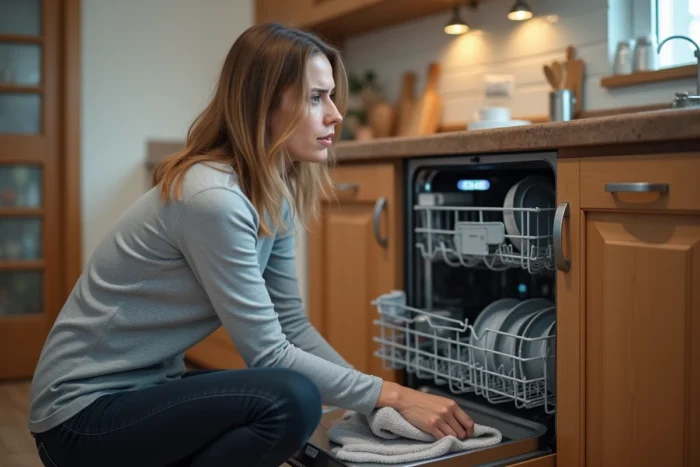
The classic trap after sealing a leak is to reconnect the appliance without properly purging the AquaStop system. Bosch recommends cutting the power supply, closing the water, and then removing all accumulated water from the base before allowing the appliance to dry. A simple superficial drying is not enough.
Specifically, we tilt the machine forward (on a thick towel) to drain the last puddles from the bottom tray. We let it dry for several hours, ideally overnight. Then:
- We replace the bottom plate and reposition the machine.
- We open the water tap and visually check for any drops at the connections.
- We reconnect the appliance and start a short empty cycle, without dishes.
If the E15 code does not reappear after this first cycle, we proceed with a normal cycle under load. Monitoring the next three cycles confirms that the repair holds.
When to call a technician for the Bosch E15 error
Two situations justify handing it over. The first: we have dried, inspected, found nothing, and the error returns nonetheless. The leak may be in a hard-to-reach place (internal circuit between the tub and the heat exchanger, micro-crack in the tub). The second: the drain pump or the AquaStop solenoid valve itself is at fault, and we do not have the tools to test them electrically (multimeter to check continuity).
A device under warranty should be entrusted to Bosch’s after-sales service. Any intervention on the hydraulic circuit by an unauthorized third party can invalidate the coverage. For an out-of-warranty device, the cost of a drain pump or hose remains moderate compared to the price of a new dishwasher, making the repair almost always worthwhile.
The E15 code is not a complex electronic failure. It is a mechanical signal: water is where it should not be. Finding out where it comes from remains the only real difficulty.